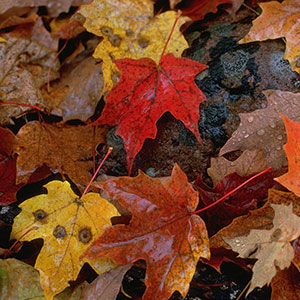
Will your lawn suffer if you don’t remove the fallen leaves from it?
In a nutshell: Yes. But forget about raking; make your mower do double duty as a leaf shredder and vacuum.
The whole story: Winter rains and snow turn fluffy layers of leaves into dense, soggy mats that can kill your grass by denying it oxygen and encouraging disease. Even during dry winters, a thick layer of leaves on your lawn blocks sunlight and reduces air circulation. If you shred your leaves into small pieces with your mower, you can leave them where they fall without suffocating your lawn.
A mulching mower—one fitted with a blade that chops leaves and grass clippings into small pieces—does the job best, but a side-discharge mower works, too. Get ready to shred by setting the mower height to 3 inches and removing the bag. It’s best to shred leaves when you can still see some grass peeking through them, which means that you may need to pull out the mower more than once this fall if you have big trees.
Begin mowing on the outside edge of your lawn, making sure that you shoot the leaves toward the middle of the yard. Mowing in this pattern also allows you to mow over the leaves more than once and keeps them from ending up on your sidewalks. If the leaves are still in fairly large pieces after your first pass, go back over the lawn at a right angle to your first cut. Finely shredded leaves filter down through the grass and easily decompose by next spring.
If a thick layer of shredded leaves buries your lawn, you must suck up the extra leaves by making one more pass over the lawn with the mower’s bag attached. You can also mow with the bag on if you want to collect leaves for your compost pile, or to use as mulch in your garden beds. It’s best to have no more than a 1-inch layer of leaf mulch on lawns and a 3-to-4-inch layer on garden beds. Mulched leaves return valuable micronutrients to your lawn and gardens (especially when mixed with grass clippings) and feed the microorganisms and worms that keep your soil—and your grass—healthy.
http://www.organicgardening.com/learn-and-grow/leave-leaves-alone
On a second note:
It’s that time of year again … time to be reminded about how nuts we all are about lawns. This came from Long Island landscaper Joseph Costanzo who has seen the light and is looking into mulching!
GOD AND ST. FRANCIS DISCUSSING LAWNS
GOD: Francis, you know all about gardens and nature. What in the world is going on down there? What happened to the dandelions, violets, thistle and stuff I started eons ago? I had a perfect, no-maintenance garden plan. Those plants grow in any type of soil, withstand drought and multiply with abandon. The nectar from the long lasting blossoms attracts butterflies, honey bees and flocks of songbirds. I expected to see a vast garden of colors by now. But all I see are these green rectangles.
ST. FRANCIS: It’s the tribes that settled there, Lord. The Suburbanites. They started calling your flowers “weeds” and went to great lengths to kill them and replace them with grass.
GOD: Grass? But it’s so boring. It’s not colorful. It doesn’t attract butterflies, birds and bees, only grubs and sod worms. It’s temperamental with temperatures. Do these Suburbanites really want all that grass growing there?
ST. FRANCIS: Apparently so, Lord. They go to great pains to grow it and keep it green. They begin each spring by fertilizing grass and poisoning any other plant that crops up in the lawn.
GOD: The spring rains and warm weather probably make grass grow really fast. That must make the Suburbanites happy.
ST. FRANCIS: Apparently not, Lord. As soon as it grows a little, they cut it-sometimes twice a week.
GOD: They cut it? Do they then bale it like hay?
ST. FRANCIS: Not exactly, Lord. Most of them rake it up and put it in bags.
GOD: They bag it? Why? Is it a cash crop? Do they sell it?
ST. FRANCIS: No Sir. Just the opposite. They pay to throw it away.
GOD: Now let me get this straight. They fertilize grass so it will grow. And when it does grow, they cut it off and pay to throw it away?
ST. FRANCIS: Yes, Sir.
GOD: These Suburbanites must be relieved in the summer when we cut back on the rain and turn up the heat. That surely slows the growth and saves them a lot of work.
ST. FRANCIS: You aren’t going to believe this Lord. When the grass stops growing so fast, they drag out hoses and pay more money to water it so they can continue to mow it and pay to get rid of it.
GOD: What nonsense. At least they kept some of the trees. That was a sheer stroke of genius, if I do say so myself. The trees grow leaves in the spring to provide beauty and shade in the summer. In the autumn they fall to the ground and form a natural blanket to keep moisture in the soil and protect the trees and bushes. Plus, as they rot, the leaves form compost to enhance the soil. It’s a natural circle of life.
ST. FRANCIS: You better sit down, Lord. The Suburbanites have drawn a new circle. As soon as the leaves fall, they rake them into great piles and pay to have them hauled away.
GOD: No. What do they do to protect the shrub and tree roots in the winter and to keep the soil moist and loose?
ST. FRANCIS: After throwing away the leaves, they go out and buy something which they call mulch. They haul it home and spread it around in place of the leaves.
GOD: And where do they get this mulch?
ST. FRANCIS: They cut down trees and grind them up to make the mulch.
GOD: Enough. I don’t want to think about this anymore. St. Catherine, you’re in charge of the arts. What movie have they scheduled for us tonight?”
ST. CATHERINE: “Dumb and Dumber”, Lord. It’s a really stupid movie about…..
GOD: Never mind, I think I just heard the whole story from St. Francis.
http://www.facebook.com/LeaveLeavesAlone/posts/792826317426317?fref=nf



 Hillsdale Environmental Commission